
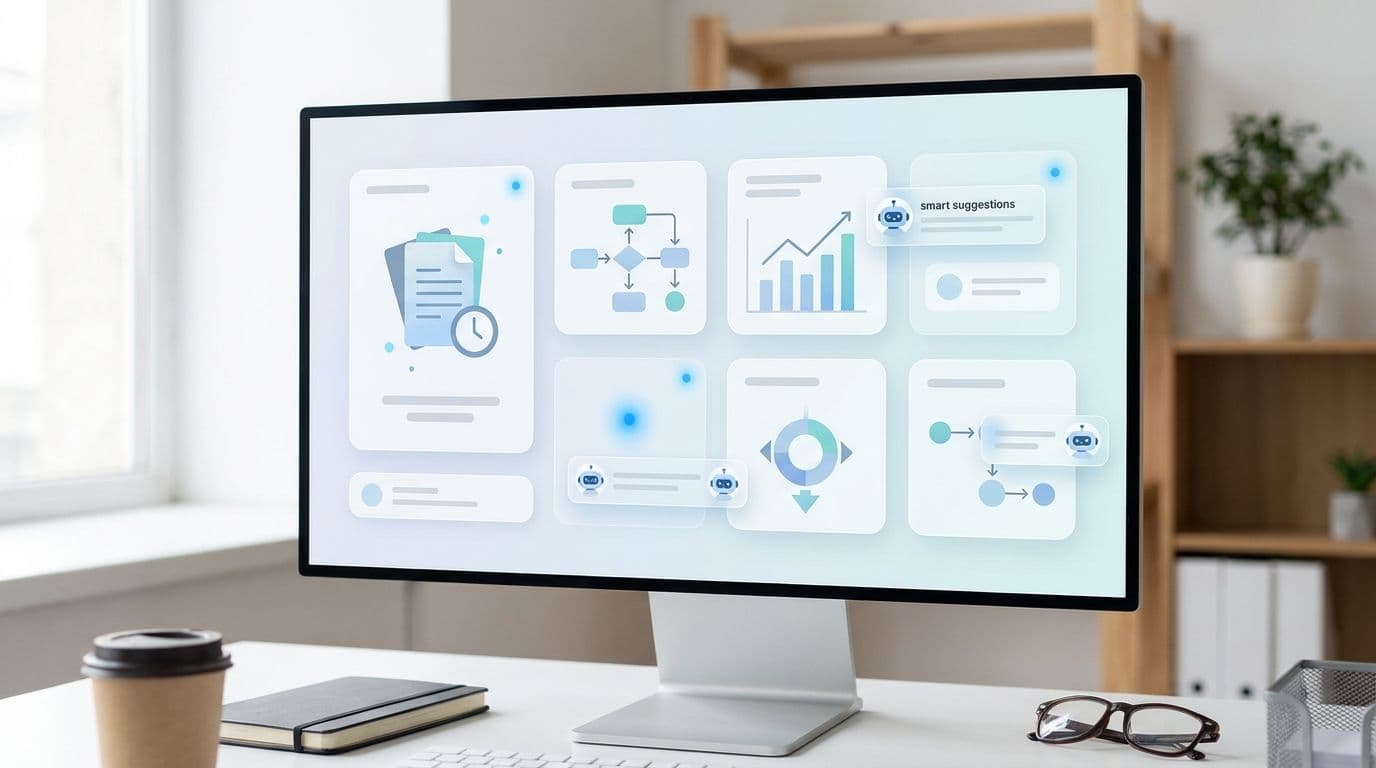
The invisible admin work slowing SMEs down
In many SMEs, the issue is not a lack of business. The real bottleneck is often hidden in repetitive administrative work: copying customer information, preparing quotes, checking statuses, following up on payments, producing documents, updating tracking files or sending the same answer again and again.
Each task looks small on its own. But repeated every week, these actions consume time, create errors and prevent teams from focusing on work that actually creates value. This is where custom business software, enhanced with practical AI, can become a concrete operational lever.
Automation does not mean replacing people
Effective automation is not about removing human judgment. It is about removing mechanical, fragile or repetitive tasks that do not need to be done manually. An SME does not necessarily need spectacular AI. It needs a reliable tool that saves time without making daily operations more complex.
For example, an internal application can automatically prepare a customer file, detect missing fields, summarize a case, suggest a suitable follow-up, classify incoming requests or create a dashboard from existing data.
People keep the decision-making role. The software prepares, organizes, checks and accelerates.
Administrative tasks that are worth automating first
The first gains usually come from processes with three characteristics: they happen often, they follow fairly stable rules, and they use information the business already has. Many administrative workflows fit this pattern.
Concrete examples include:
- generating quotes or documents from a customer file;
- automatic follow-ups based on case status;
- tracking incoming requests from a form or mailbox;
- assigning tasks to the right person;
- creating weekly reports;
- checking for missing information;
- centralizing customer conversations;
- automatically summarizing a case or field intervention.
The goal is not to automate everything. The goal is to identify the steps that waste time or create errors, then improve them one by one.
Why custom software instead of a generic tool?
A generic tool can be enough for a simple need: calendar, standard invoicing, forms or a basic CRM. But as soon as your process depends on internal rules, specific documents, business-specific steps or integrations between several tools, the limitations appear quickly.
Custom business software starts from the way your company really works. It can connect to existing data, respect your validation steps, display the indicators that actually matter and automate only what makes sense for your activity.
This is especially useful for local businesses, trades, agencies, offices, service providers and SMEs that already have an effective process, but lose time making it work through files, emails and tools that do not communicate.
Where AI brings real value
AI becomes useful when it helps process unstructured information: emails, notes, comments, request descriptions, reports, files or customer histories. It can summarize, classify, rewrite, extract information or suggest an action.
But it needs boundaries. For an SME, a good AI integration should remain transparent: the user understands what the tool is doing, can correct the output and keeps control over important decisions. AI should not run the company for you. It should reduce friction.
Start with a realistic scope
The right starting point is one business flow. For example: from customer request to quote, from field intervention to invoice, from form submission to complete file, or from incoming email to assigned task. This scope makes it possible to build a first version that is useful, measurable and quick to test.
A first version can include:
- a simple input area;
- a centralized customer or case database;
- a clear status for each request;
- a few follow-up or notification automations;
- a dashboard;
- a limited but useful AI feature, such as summarization or classification.
This approach avoids heavy projects. It allows the business to validate real operational value before adding more modules.
The right metric: less wasted time, better visibility
A successful automation project is easy to measure: less duplicate entry, fewer forgotten follow-ups, fewer errors, fewer scattered files and a clearer view of activity. If managers see bottlenecks faster, if the team knows what to do next and if information is reliable, the tool is already serving a strategic purpose.
Want automation without unnecessary complexity?
MEITRIZ helps SMEs and independent professionals turn manual processes into clear, reliable and profitable business applications. Based in Toulon, in the Var area, and available remotely, I can help identify automatable tasks, define a realistic first version and build a tool adapted to your business.
If your company loses time in emails, spreadsheets, copy-paste work or manual follow-ups, the right first step is often a quick audit of your workflow. From there, we can build useful software, not a gadget.